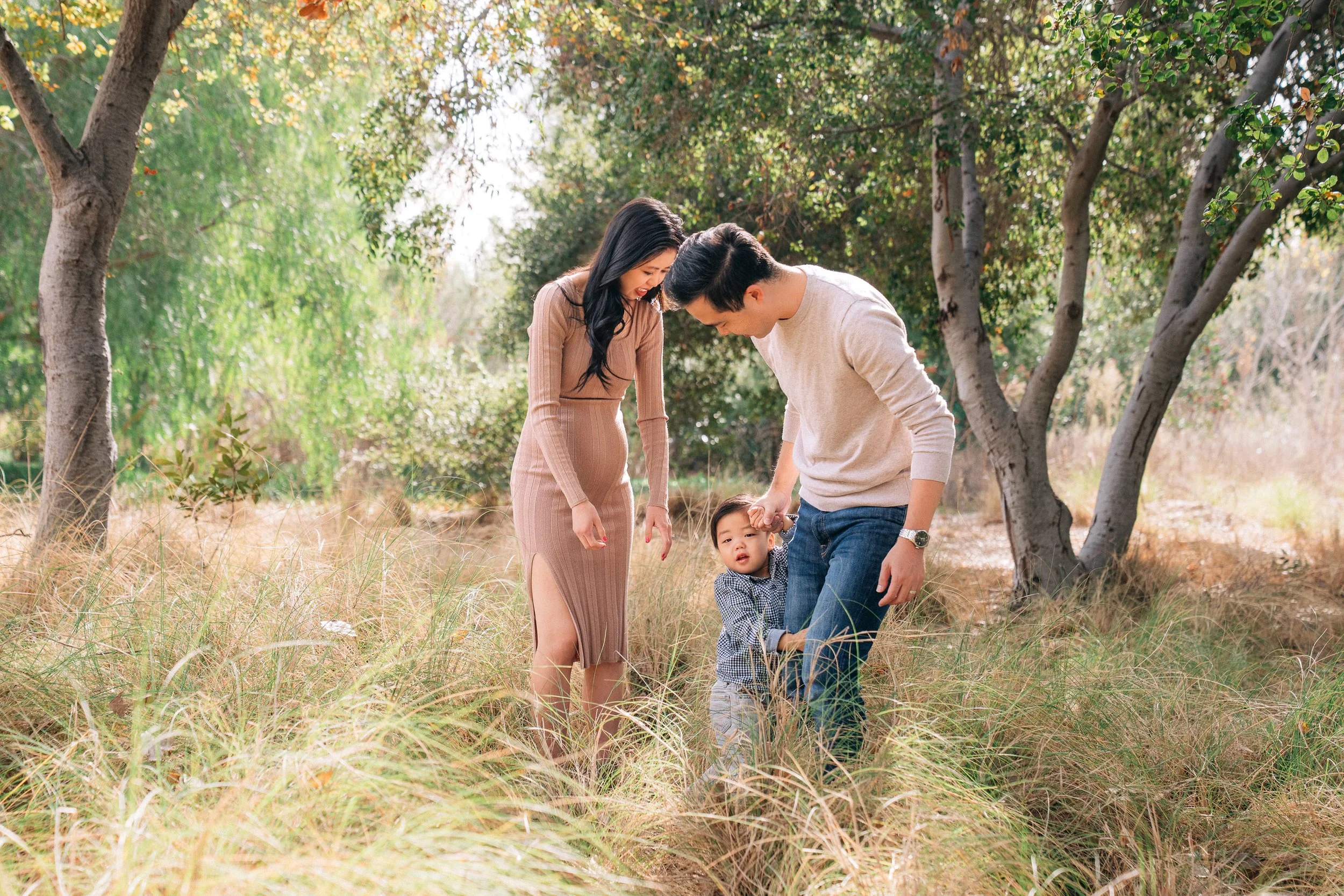
Oh hello there shy little one.
Family sessions · Orange County & Los Angeles
The eyes have it.
"Where should we look?" is the question I get at almost every session, usually from a parent who wants to help. The short answer is that it depends on your family, and sorting it out is my job, not yours. The longer answer is below, and it gets a little film-nerdy.
I spent film school learning that two things decide how a scene feels before anyone says a line: where the actors are looking, and where the camera is standing. Those are two separate dials. A kid looking at her dad reads one way. The same kid looking at me reads another. Both change again depending on whether I'm across the yard or lying in the grass next to her.
None of this is homework. There's no quiz, and you won't need to remember any of it on the day. I'm walking through it because once you see it, you'll start spotting it in your own pictures, and because it helps to know how many options you actually have.
Part one
Where the eyes go
Four places a person can look, and what each one does to the picture.
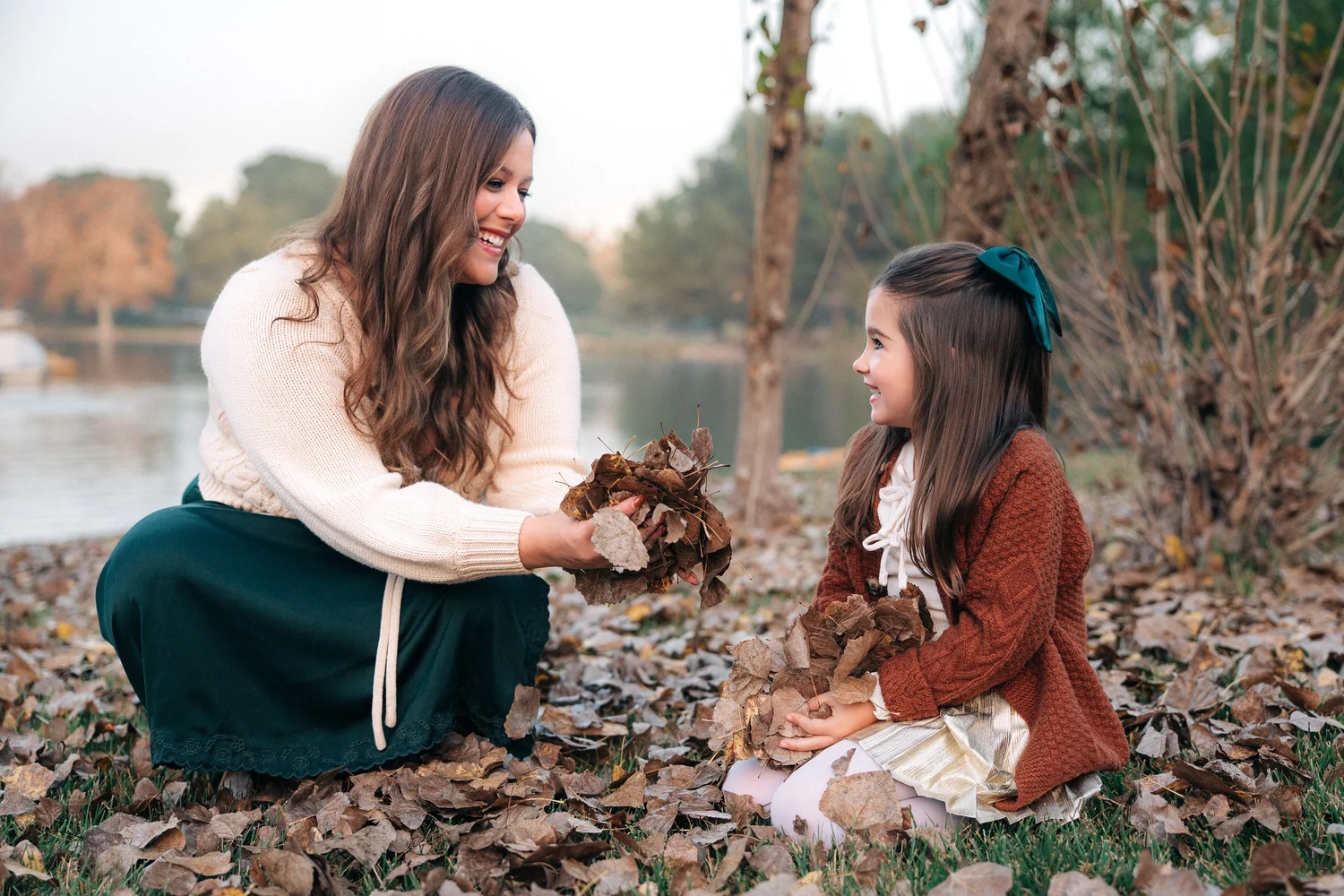
Eyes on each other
When you look at each other, the camera turns into an observer. Nobody in the frame is addressing the viewer, so the viewer gets to watch a relationship instead of being greeted by one. In a film this is nearly every scene: two characters, the audience looking on, the camera never acknowledged.
Looking at each other rarely means holding a meaningful stare. Mostly it means doing something together. Gathering leaves. Arguing over who gets to carry the stick. Reading the same page of a book. Your attention lands on each other because you're busy, and that's what makes the picture look like a Saturday afternoon instead of a photo shoot.
Eyes on the lens
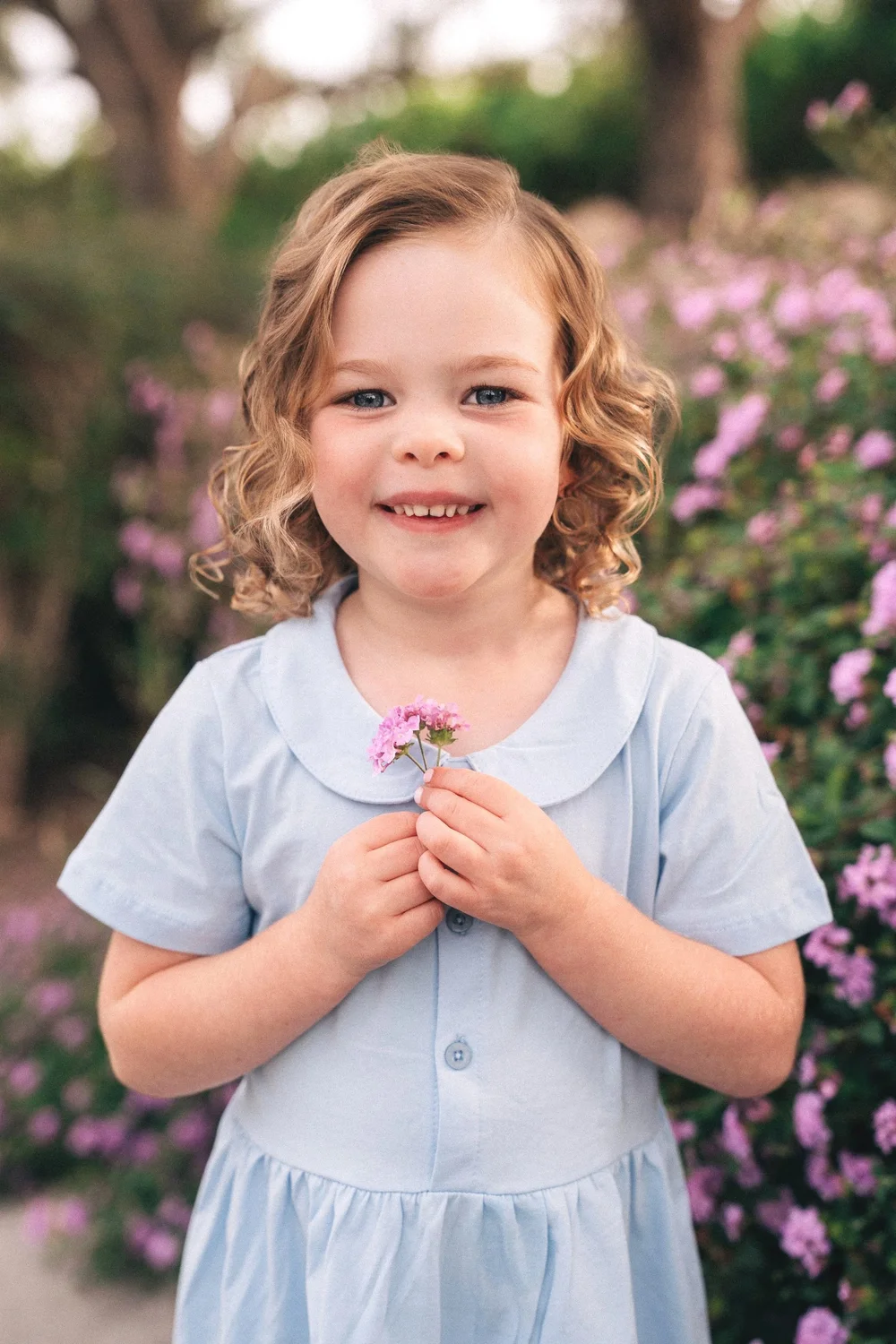
In a movie, when a character looks straight into the camera, it's called breaking the fourth wall. The film has spent an hour pretending you aren't there, and then someone looks right at you. Ferris Bueller built an entire movie on it.
In a photograph, a look into the lens does something similar. It connects the person in the picture to the person holding it. That doesn't mean it has to be bold or beaming. A direct look can be playful, thoughtful, relaxed, or completely serious. A four-year-old who looks me dead in the eye without smiling is giving me something a grin can't.
The one formal portrait my family ever had taken was at a JCPenney when I was about six. All of us looking straight at the camera, and I'm almost positive the bribe was an Orange Julius. It sat on a table for half my life, so I'm not here to knock the camera-facing portrait. We'll get the one for Grandma. I just think it deserves company, which is why I keep shooting through the twenty seconds after it.
And if looking at the camera makes you feel like you're renewing a passport, tell me. I'll keep those short, cue them lightly, and lean on everything else for most of the hour.
Eyes near the lens
This one has no fancy name and does a lot of the work. If you look at someone standing right beside me, your eyes land near the lens without landing in it. Documentary interviews are shot this way on purpose: the subject talks to the interviewer sitting next to the camera, so it feels like a conversation you're overhearing instead of a pitch aimed at you. (Errol Morris built a rig of mirrors specifically to get eyes into the lens instead. The difference is that noticeable.)
With families, this is what I reach for when a kid has no interest in a stranger holding a black box. I don't need them to look at me. I need Mom just off my shoulder doing the voice she swears she doesn't do. Their face lights up for her, their eyes land right next to the lens, and the picture reads as warm without the kid ever having to deal with a camera.
So no, you don't need to make your child look at me. Please don't. The "look at the camera, look at the camera" voice produces one very specific face, and we can skip it.
Eyes in different directions
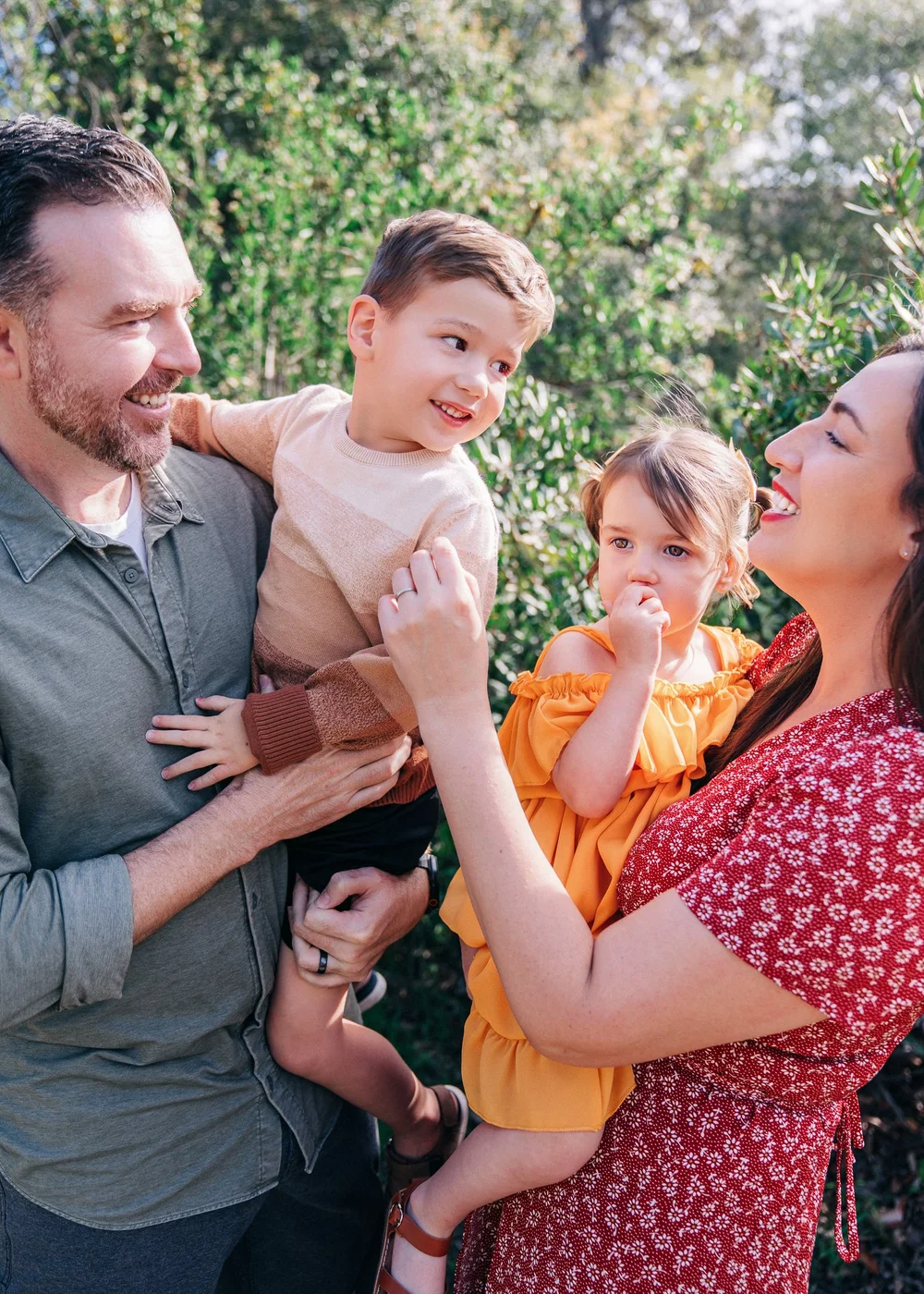
The option nobody mentions. People can look in completely different directions and the photograph still holds together, often better than if everyone matched. Mom watches the kid. The kid watches Dad. Dad watches the dog leave with a sandwich. Each gaze points somewhere, and together they tell you who's paying attention to whom.
In film this is called blocking, and it's most of what makes a scene work. You can tell who matters to whom in a room without a line of dialogue, just by following the eyes.
Part two
Where the camera sits
Eye direction is half of it. Where I put the camera decides who the viewer gets to be.
Point of view
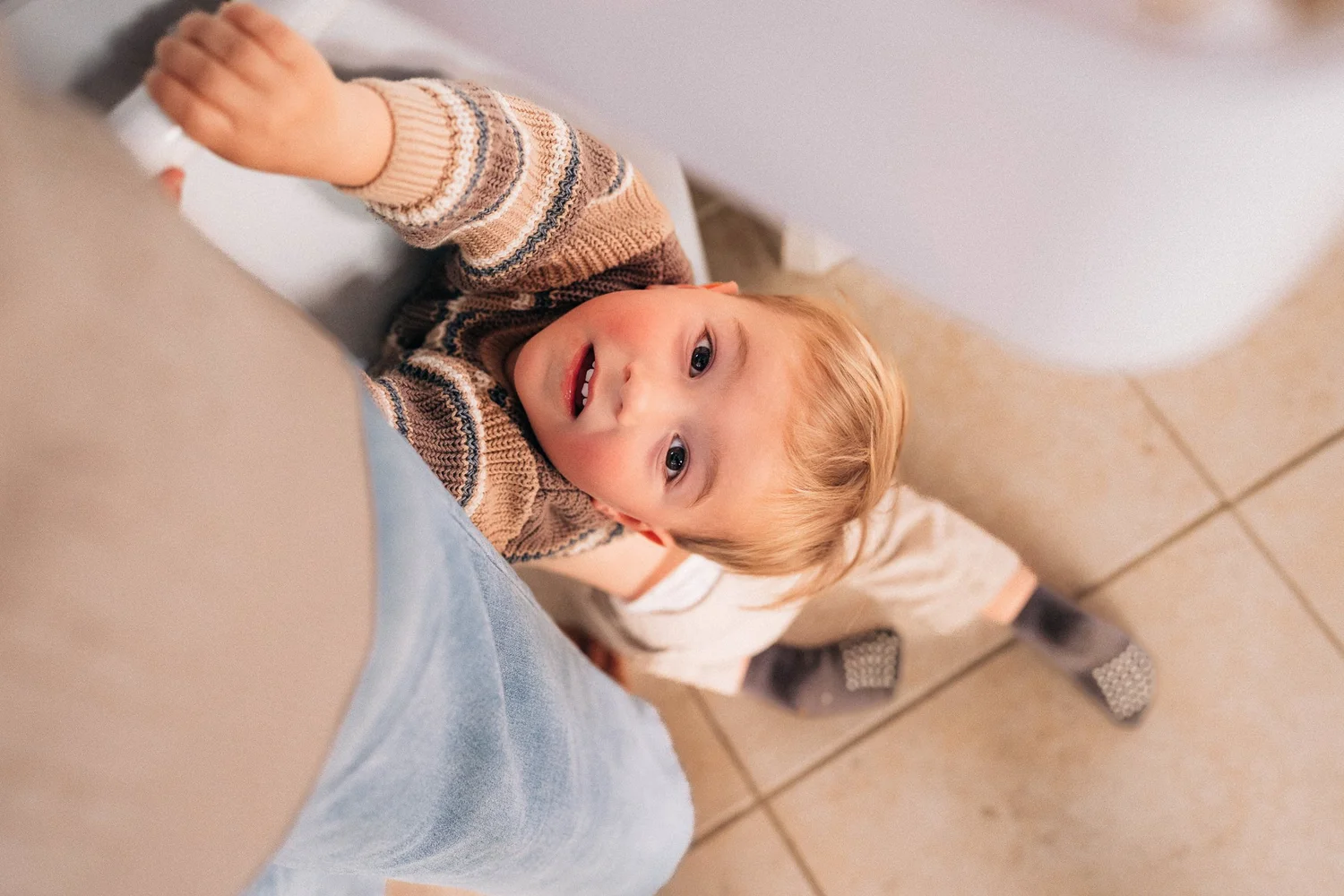
A POV shot puts the camera where a person's eyes would be. In a film it's the hallway the character walks down, the letter as they read it. In a session it's me getting the camera to where your eyes already are, so the picture looks the way you remember it rather than the way a photographer across the room saw it. The kid hanging off the fridge door while you grab a snack, grinning up at you. The top of a head on your chest.
Whoever's view we borrow doesn't have to be in the frame at all. That's the point. You aren't looking at the picture so much as standing inside it.
Over the shoulder
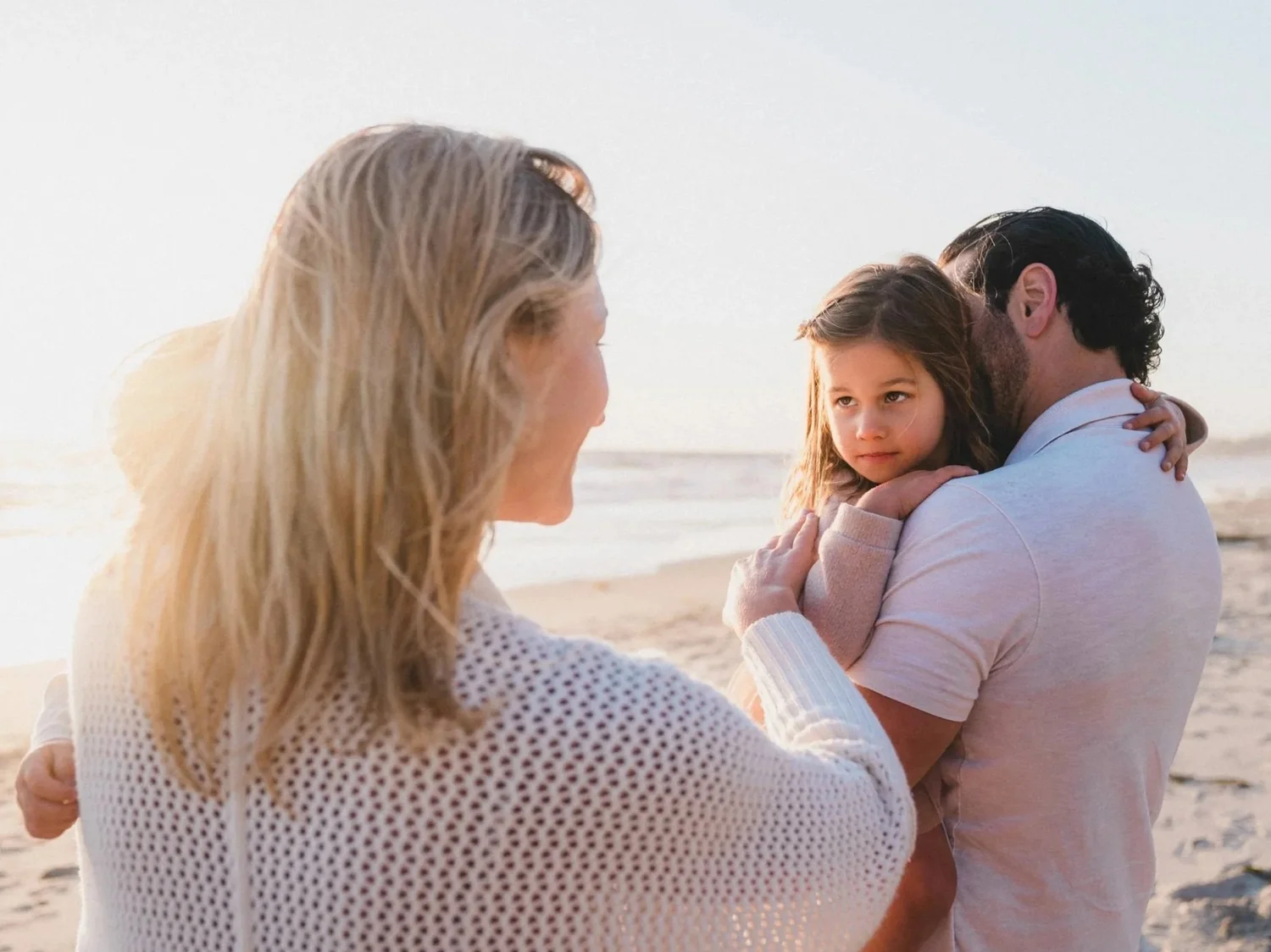
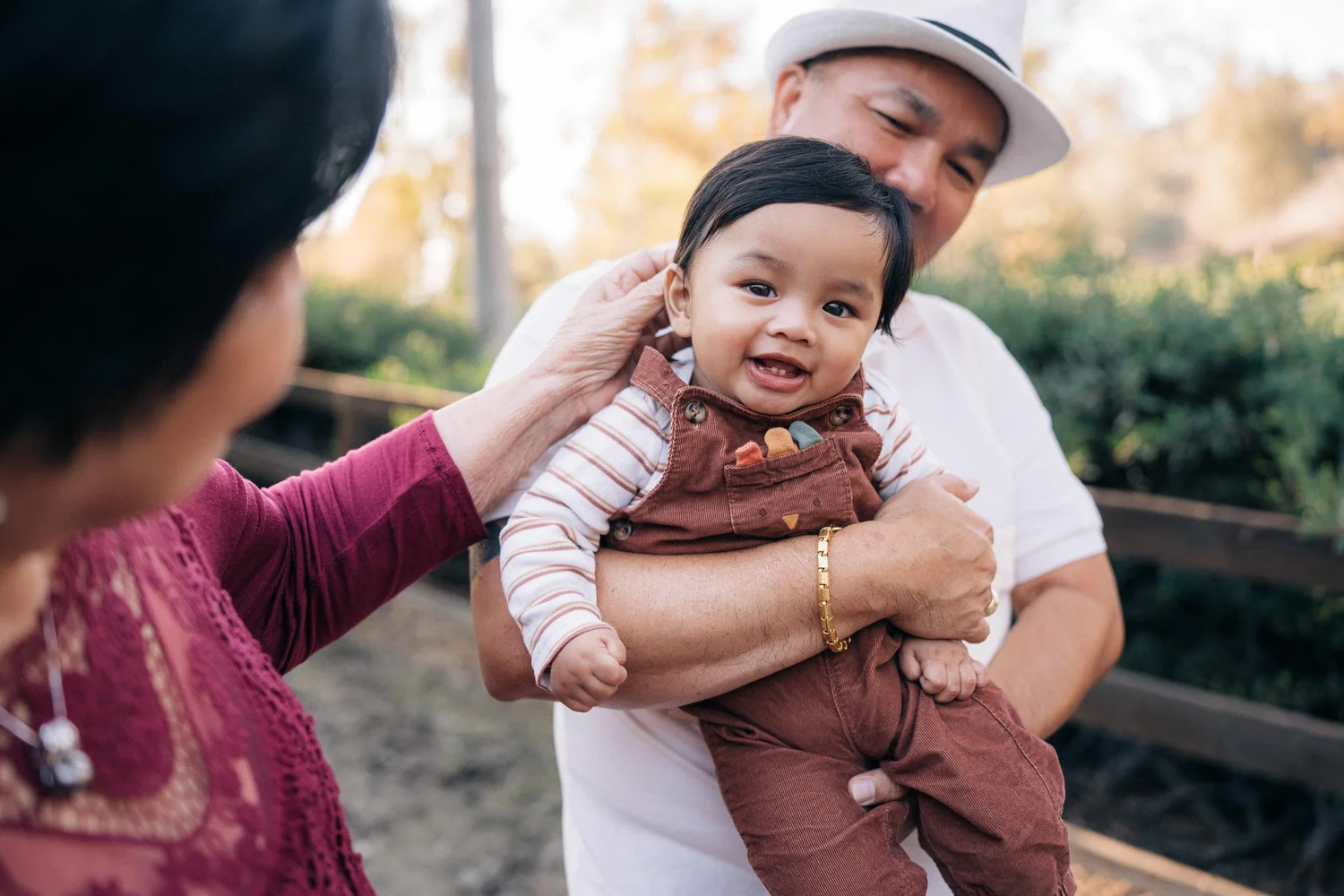
Over-the-shoulder framing keeps a piece of one person in the picture, a shoulder, the back of a head, a sleeve, and shows the other person past it. Film uses it for conversations. You aren't seeing through someone's eyes like a POV; you're standing just behind them, and part of them stays in the frame as a reminder of where you are.
It's useful because it lets everyone keep looking at each other while the viewer still gets a face. Nobody has to turn toward the camera, and the picture is still clear about who's who. The beach picture up in Part one is one too: hair and a shoulder in the foreground, and past them, the other two.
And a two-shot? Just film shorthand for two people in the frame. The leaves picture is a two-shot. The beach has three people, so it's technically a three-shot framed over a shoulder, which is the kind of sentence I will absolutely say out loud at a dinner party.
Part three
How I actually use this
These are tools I respond with, not a checklist I run every family through.
The part where you stop keeping track
I guide people. I'll give you a pose to start from, a prompt, something to do with your hands, a direction to walk, and then I pay attention to what happens next, because what happens after the prompt is usually better than the prompt. Direction and real life aren't opposites. Most of the time the direction is what makes room for the unplanned part.
Which tools I reach for depends on who you are. A quiet kid gets a lot of near-the-lens and over-the-shoulder, because asking her to stare down a stranger is a big ask. An affectionate couple gets eyes-on-each-other almost without trying. A family currently negotiating custody of a single granola bar gets whatever's happening, from wherever I can get to in time.
So there's always a plan. It just starts with your family and works out from there, not the other way around.
Worth knowing
Before your session
- 1If looking at the camera feels awkward, say so. I'll keep those short and build the hour around the other options.
- 2You don't need to make your kid look at me. I'll give them a reason to look where I need them to, and the reason is usually you.
- 3Looking at each other mostly means doing something together. Nobody has to hold a stare.
- 4There's room for the classic camera-facing portrait right next to the playful, quiet, and unexpected ones. The one you end up framing might be your kid buried in a hug.
The short version
You have options. I'll help.
Your family gets to be itself, and I'll handle where everyone is looking. If you want to talk through what yours might look like, tell me who's coming and what you're picturing, and we'll work out the rest.
Check availability